
GST Invoice Number Format Rules: 16 Characters, Series, Yearly Reset
Rule 46(b) is one sentence long, and it is enough to reject an invoice at the IRP or a Table 13 upload. Here is what the sentence requires, what it allows, and how to design a series that never fails.
On this page
Key takeaways
- A GST invoice number must be consecutive, no longer than 16 characters, made only of letters, numbers, hyphen and slash, and unique within the financial year.
- Multiple series are allowed, so branches, product lines or channels can each have a prefix, as long as each series is consecutive and reported separately in Table 13.
- The IRP adds its own checks: no number starting with 0, slash or hyphen, and no duplicates for the same GSTIN, document type and financial year.
- Every document type (invoice, credit note, debit note, delivery challan, bill of supply, vouchers) carries its own series under the same rules.
Rule 46(b) of the CGST Rules says a tax invoice must carry "a consecutive serial number not exceeding sixteen characters, in one or multiple series, containing alphabets or numerals or special characters, hyphen or dash and slash symbolised as '-' and '/' respectively, and any combination thereof, unique for a financial year". That one sentence sets every rule about GST invoice numbers, and every failure at the IRP, in the GSTR-1 offline tool or in Table 13 traces back to one clause of it.
This guide takes the sentence apart clause by clause, adds the checks that the Invoice Registration Portal layers on top, and shows how to design a numbering scheme that passes all of them. It is written for anyone who sets up invoicing, whether in software, in a template or for a client.
For the rest of the invoice, field by field, see the GST invoice format guide. For the practical job of restarting a series on 1 April, see how to reset invoice numbering for the new financial year.
The rule, clause by clause
Consecutive. The numbers in a series go up by one with each document. Gaps are permitted only for cancelled documents, and those are reported. An invoice numbered 0104 following 0102 with no 0103 anywhere is a question waiting to be asked.
Serial number. The number identifies the document, not the customer or the order. Embedding a customer code is allowed as a prefix if it still leaves a consecutive serial, but it usually pushes the string past 16 characters and creates a series per customer, each of which must be consecutive.
Not exceeding sixteen characters. The count is of the entire string as printed and reported. Prefix, separators and serial together.
In one or multiple series. You may run several series in parallel. Each must independently satisfy every other clause.
Alphabets, numerals, hyphen and slash. Nothing else. Upper and lower case letters are both allowed, but mixed case in a series is a reliable source of duplicates in spreadsheets, so pick one.
Unique for a financial year. No two tax invoices from the same GSTIN carry the same number in the same year. The rule does not require uniqueness across years, which is why a reset is possible.
Bill of supply and other documents use the same clause
Rule 49 for bills of supply, Rule 53 for revised invoices and credit and debit notes, Rule 55 for delivery challans and Rule 50 to 52 for vouchers all repeat the same numbering language. One design serves every document type; only the prefix changes.
The 16-character limit in practice
Sixteen is smaller than it sounds once a prefix is added.
| Number | Characters | Passes | Note |
|---|---|---|---|
| INV/27-28/00001 | 15 | Yes | Year prefix, five-digit serial |
| INV-2728-000001 | 15 | Yes | Six-digit serial, compact year |
| MUM/INV/27-28/001 | 17 | No | Branch plus year plus type is too long |
| 2728/000001 | 11 | Yes | Passes, but the type is not obvious |
| INV/2027-2028/001 | 17 | No | Full years breach the limit |
| A1 | 2 | Yes | Legal, but leaves no room to grow |
| INV 0001 | 8 | No | Space is not an allowed character |
| INV.0001 | 8 | No | Full stop is not an allowed character |
| 0001 | 4 | Rule 46 yes, IRP no | Starts with 0 |
Two habits keep the count under control. Use two-digit years (27-28, not 2027-28). Choose one identifier in the prefix, either the document type or the branch, not both, unless the serial can be short.
Multiple series: when they help and when they hurt
Multiple series are useful in four situations.
- Multiple GSTINs. Each registration is a separate taxpayer for GST purposes and needs its own series anyway; a state code prefix keeps them apart when one accountant files for all.
- Branches under one GSTIN. A branch prefix lets each location issue invoices without a shared counter, which matters when they are offline from each other.
- Channels. Marketplace orders, direct website orders and manual B2B invoices often come from different systems. A prefix per channel avoids a shared counter across systems that cannot coordinate.
- Document types. This is not optional; a credit note series is distinct from the invoice series by nature.
They hurt when they multiply without reason. Twenty series for twenty product lines means twenty rows in Table 13 every month and twenty places a gap can appear. Keep the count of series to the number of systems or locations that genuinely cannot share a counter.
Each series must be consecutive on its own, and each is reported on its own row in GSTR-1 Table 13 with its first and last number, total, cancelled and net. The GSTR-1 filing guide covers the table.
Unique per financial year: reset or continue
Because uniqueness is required within the year and not across years, a business has two compliant options on 1 April.
Reset to 1 with a new year prefix. INV/26-27/00450 in March becomes INV/27-28/00001 in April. The prefix guarantees uniqueness across years as well, so an old number can never be mistaken for a new one.
Continue the count. INV/26-27/00450 in March is followed by INV/27-28/00451 in April, or simply INV-00451 with no year at all. Also compliant, provided nothing in FY 2027-28 repeats.
What is not compliant is a restart within the year. Changing software in October and starting again at 1 with the same prefix produces duplicates inside FY 2027-28. If a mid-year change is unavoidable, change the prefix too, so the new series is distinct and reported as a separate row in Table 13 from that month.
Numbering rules that apply to every series
- Consecutive, with cancellations recorded rather than deleted
- 16 characters or fewer, counted as printed
- Letters, numbers, hyphen and slash only
- Unique within the financial year for the GSTIN
- Separate series per document type
- One case (upper or lower), never mixed
- Reported in Table 13 with first, last, total and cancelled
What the IRP adds for e-invoices
Businesses with aggregate turnover above Rs 5 crore must register B2B invoices, credit notes and debit notes on the Invoice Registration Portal and obtain an IRN. The IRP validates the document number with rules of its own, on top of Rule 46.
- The number must not begin with 0, slash or hyphen. 0001 is rejected; A0001 and INV/0001 are accepted.
- The number must be unique for the GSTIN, document type and financial year. A second upload with the same number is rejected as a duplicate, even if the first was for a different customer.
- The 16-character limit and the character set are enforced at upload.
- Once an IRN is generated, the invoice can be cancelled on the IRP within 24 hours. After that it stands, and correction is by credit note and a fresh invoice with a new number.
- If aggregate turnover is Rs 10 crore or more, the invoice must be reported to the IRP within 30 days of the invoice date. An invoice numbered and dated but not uploaded within that window cannot be registered.
IRP checks on the document number
- Does not start with 0, slash or hyphen
- 16 characters or fewer, letters, numbers, hyphen and slash only
- Not already registered for this GSTIN, document type and financial year
- Final before upload; never edited after the IRN is generated
- Uploaded within 30 days of the invoice date if turnover is Rs 10 crore or more
The IRN itself is a 64-character hash generated by the IRP; it does not replace your invoice number and is not subject to the 16-character limit. Your number is one of the inputs to the hash, which is why it must be final before upload. The e-invoicing guide covers the full flow.
Number before you register, never after
An e-invoice is a registered document. Software that assigns the number after IRP success, or that allows the number to be edited afterward, produces an invoice whose printed number differs from the registered one. Assign the number first, then register.
One series per document type
Every GST document with a serial number requirement gets its own series. Sharing one counter between invoices and credit notes is a common mistake in spreadsheet setups and it fails Table 13, which expects a row per document type.
- Tax invoice: for taxable supplies by a registered person.
- Bill of supply: for exempt supplies and for composition dealers, under Rule 49.
- Revised invoice: issued between registration effective date and certificate date, under Rule 53.
- Credit note and debit note: under Section 34 and Rule 53, each with its own series, referencing the original invoice.
- Delivery challan: for movement without a sale, job work, or goods sent on approval, under Rule 55. The delivery challan guide explains when one replaces an invoice.
- Receipt voucher, refund voucher and payment voucher: for advances, refunds of advances and reverse charge payments, under Rules 50 to 52.
Proforma invoices, quotations and purchase orders are commercial documents with no GST series requirement, but numbering them on the same design avoids confusion.
Common mistakes and their cost
| Mistake | What breaks | Correction |
|---|---|---|
| Prefix pushes past 16 characters | GSTR-1 upload and IRP reject | Shorten the prefix for all future documents |
| Number begins with 0 | IRP rejects | Add a letter prefix |
| Space or dot in the number | Offline tool and IRP reject | Use hyphen or slash |
| Same number for invoice and credit note | Table 13 mismatch, customer confusion | Separate series per document type |
| Restart at 1 mid-year, same prefix | Duplicate within the year, Rule 46 breach | New prefix for the new series |
| Deleted invoice | Gap in Table 13 | Cancel instead, report as cancelled |
| Number edited after issue | Customer's copy and your GSTR-1 disagree | Credit note plus fresh invoice |
| Two systems, one prefix, separate counters | Duplicates, IRP rejections | One counter or one prefix per system |
The cost of each is a correction cycle: cancel or credit note, reissue, explain to the customer, and amend GSTR-1 through GSTR-1A if the return is already filed. The GST billing mistakes guide covers what these look like across a year.
Designing a series that never fails
A design that satisfies every check above, for a business with one GSTIN, one sales system and modest volume:
- Tax invoice: INV/27-28/00001, 15 characters, 99,999 per year
- Credit note: CN/27-28/00001, 14 characters
- Debit note: DN/27-28/00001, 14 characters
- Delivery challan: DC/27-28/00001, 14 characters
- Receipt voucher: RV/27-28/00001, 14 characters
- Bill of supply: BOS/27-28/00001, 15 characters
For a second GSTIN or a second branch, add a two or three letter code and drop one digit of padding: DL/INV/27-28/0001 is 17 and fails, but DLINV/27-28/0001 is 16 and passes, or use DL-INV-2728-0001 at 16. Count before committing.
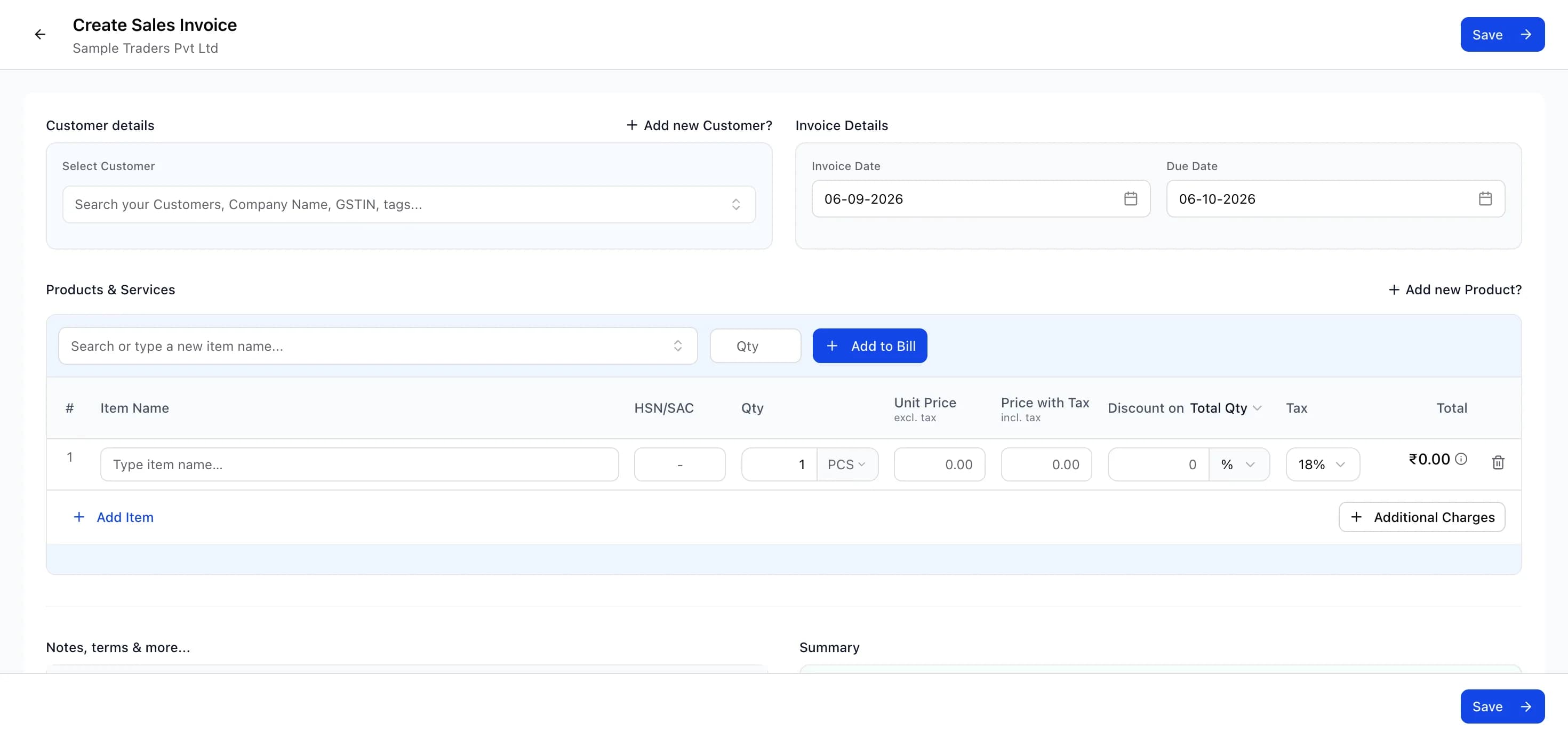
In billing software the series is a setting per document type: prefix, next number, padding, and often a financial year rule that resets the counter on 1 April. myBillPlease exposes these per document across its 14-plus document types and applies the series to invoices generated automatically from orders, so the number is assigned at creation and never edited. The free plan covers 100 invoices a month for one user with no card.
Checking an existing series
If invoices are already flowing, audit the series before the next GSTR-1 rather than at year end.
- Export every document issued this financial year with its number, type and date.
- Sort by type and number and look for duplicates, gaps that are not cancellations, and any number over 16 characters or containing a disallowed character.
- Check that no number starts with 0, slash or hyphen if you are, or expect to be, above the e-invoicing threshold.
- Confirm each type has its own series and that Table 13 in the last filed GSTR-1 shows one row per series with matching first and last numbers.
- Fix the settings for future documents. Do not renumber issued documents; correct them by credit note and fresh invoice only where the number is actually invalid.
The GST audit checklist puts this alongside the other document checks a department review covers.
Frequently asked questions
- What is the maximum length of a GST invoice number?
- Sixteen characters, counting every letter, digit, hyphen and slash. A prefix such as INV/27-28/ uses ten of them, leaving six for the serial.
- Which characters are allowed in a GST invoice number?
- Letters, numerals, and the two special characters hyphen (-) and slash (/), in any combination. Spaces, full stops, underscores, hash and brackets are not permitted.
- Does the invoice number have to restart every financial year?
- No. It must be unique within a financial year and consecutive.
- Can I use more than one invoice series?
- Yes. Rule 46 allows one or multiple series. Businesses use separate series per branch, per state registration, per sales channel or per document type.
- What happens if I skip a number or delete an invoice?
- A gap in the series shows up in Table 13 as a mismatch between the range and the count, and it invites a question about the missing document.
- Do credit notes and delivery challans follow the same numbering rules?
- Yes.
- Can an invoice number be changed after it is issued?
- No. Once issued, the number is part of the document the customer holds and, above the e-invoicing threshold, is registered on the IRP.