

GST Return Filing for Shopify Sellers in India (GSTR-1/3B from your orders)
A Shopify store is not a marketplace, so nobody collects TCS or prints invoices for you. Every order needs its own GST invoice, and GSTR-1 and GSTR-3B are built from those invoices. Here is the order-to-return path, table by table.

On this page
Key takeaways
- Shopify is not an e-commerce operator under Section 52 for your own store, so there is no TCS and no Table 14; your sales are ordinary B2C or B2B supplies in GSTR-1.
- Shipping goods to another state makes registration compulsory under Section 24(i) regardless of turnover, which covers almost every Indian Shopify store.
- Every order needs a tax invoice under Section 31 at dispatch, with the place of supply taken from the shipping address; refunds and RTO are credit notes against that invoice.
- GSTR-1 (Table 7, 5, 4, 9B, 12 and 13) and the GSTR-3B summary come from those invoices, filed by the 11th and 20th, with ITC on gateway, courier and app invoices matched to GSTR-2B.
GST return filing for a Shopify seller in India starts from a fact that marketplace sellers never face: nobody else collects TCS, prints invoices or reports your sales. Your store is your own supply, so every order needs a tax invoice under Section 31, every refund needs a credit note, and GSTR-1 by the 11th and GSTR-3B by the 20th are built from those documents. Get the invoice right at the order and the returns are a summary of what already exists.
That is also the advantage. There is no Table 14, no TCS to accept, no GSTR-8 to reconcile against, and no marketplace numbering to import. The whole compliance chain is order, invoice, credit note where needed, return. This guide follows that chain: who needs to register, what each order's invoice must carry, how orders map to GSTR-1 tables, how refunds and RTO are handled, and what goes into GSTR-3B.
If you sell on Shopify and on a marketplace, the marketplace half is covered in the ecommerce seller GST guide. This post is about the store you own.
Is a Shopify seller an e-commerce seller under GST
Not in the Section 52 sense. An e-commerce operator collects TCS when other suppliers sell through its platform and it collects the money. On your own Shopify store you are the supplier, the payment comes to your gateway account, and Shopify is a software vendor. No TCS is collected, nothing appears in GSTR-8, and your sales are reported as ordinary supplies.
Registration works differently too. The marketplace rule that forces registration regardless of turnover applies to supplies through an operator, which your store is not. What catches almost every Shopify seller instead is Section 24(i): any inter-state taxable supply of goods requires registration, with no threshold. A store in Jaipur shipping to Mumbai has made an inter-state supply. Only a store that sells goods within one state stays under the Rs 40 lakh or Rs 20 lakh threshold rules. Inter-state services have a separate exemption up to the threshold; check the GST portal for the current notification if you sell services.
Composition dealers cannot make inter-state supplies, so a composition store can ship only within its state. The composition scheme guide covers when that trade-off is worth it, and the new business GST checklist covers what to set up at registration.
Every Shopify order needs a GST invoice
Section 31 requires a tax invoice for every supply of goods, issued before or at removal. For an online order that means at dispatch, whether the order was prepaid or cash on delivery. The invoice must carry the Rule 46 fields: your name, address and GSTIN; a serial number unique for the financial year, 16 characters or fewer; date; the customer's name and, for a registered buyer, their GSTIN; place of supply; HSN; quantity; taxable value; rate; and the tax split by head.
Three details decide whether the invoice is right.
- Place of supply is the shipping address state, not the billing address and not your state. It decides whether the invoice carries IGST or CGST plus SGST.
- Shipping charged to the customer is part of a composite supply with the goods and takes the goods' rate. A Rs 60 shipping line on a 5 percent product is taxed at 5 percent, not 18.
- Discounts shown on the order reduce the taxable value on the invoice when they are known at the time of supply, which a checkout discount is.
For an unregistered customer, the invoice is a B2C invoice. If the value is Rs 50,000 or more, the customer's name and address must be on it, which the shipping address already gives you. A B2B customer needs a way to give you their GSTIN at checkout, through a cart note or a customer field, so the invoice can carry it and land in their GSTR-2B.
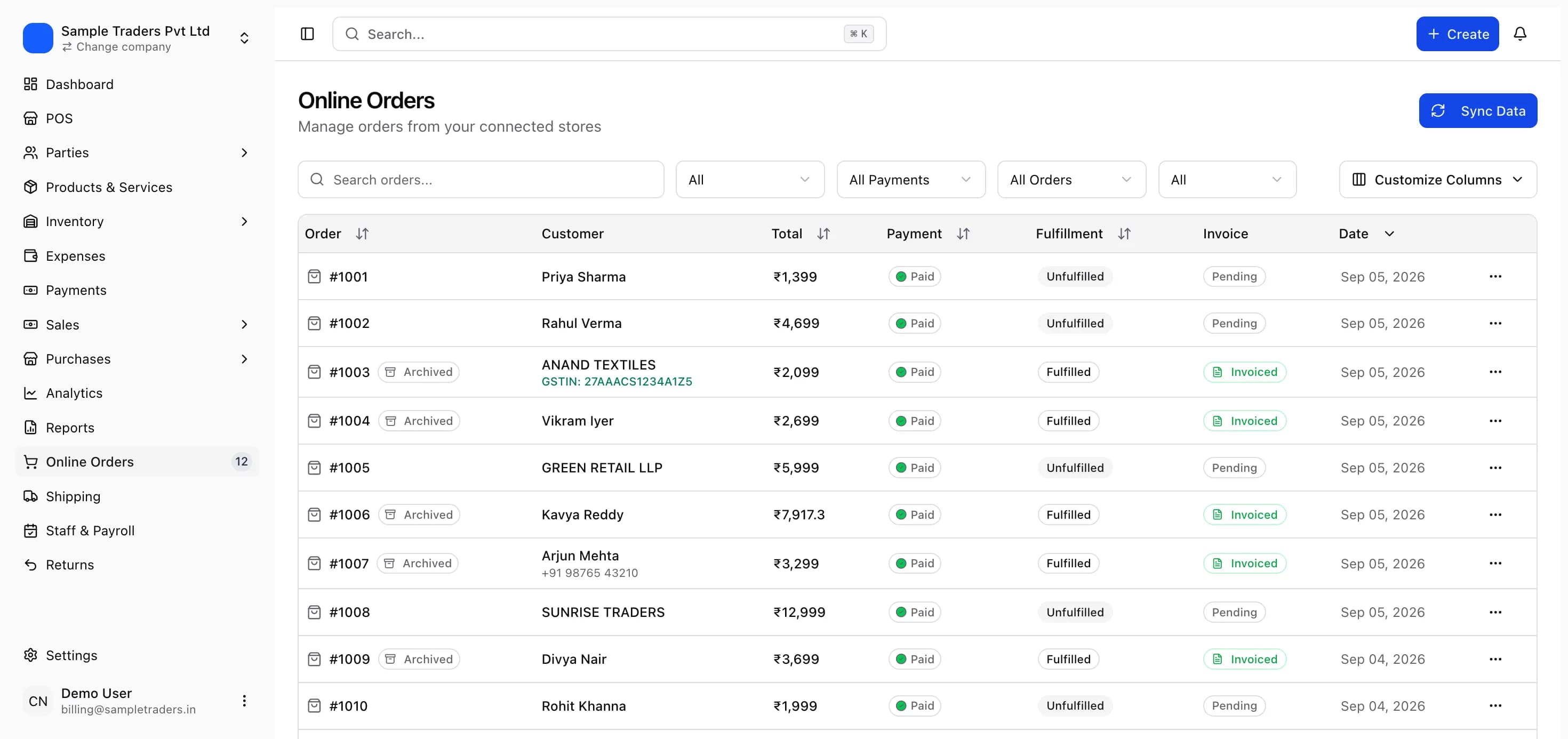
A Shopify order confirmation is not a tax invoice
The email Shopify sends the customer is an order confirmation. It has no GSTIN, no HSN, no tax split by head and no Rule 46 serial number. Sending it as the invoice means the customer holds no valid document and your GSTR-1 has nothing to be built from. Generate a tax invoice for every order, by app or by hand.
Turning orders into invoices
The efficient way is to generate the invoice from the order the moment it is placed or fulfilled, from a product master that already carries the HSN and rate for each SKU. An app that creates a GST invoice on every Shopify order does exactly that, using the shipping address for place of supply, the SKU mapping for HSN and rate, and your numbering series for the serial number. myBillPlease's Shopify app works this way, and the free plan covers up to 100 invoices a month.
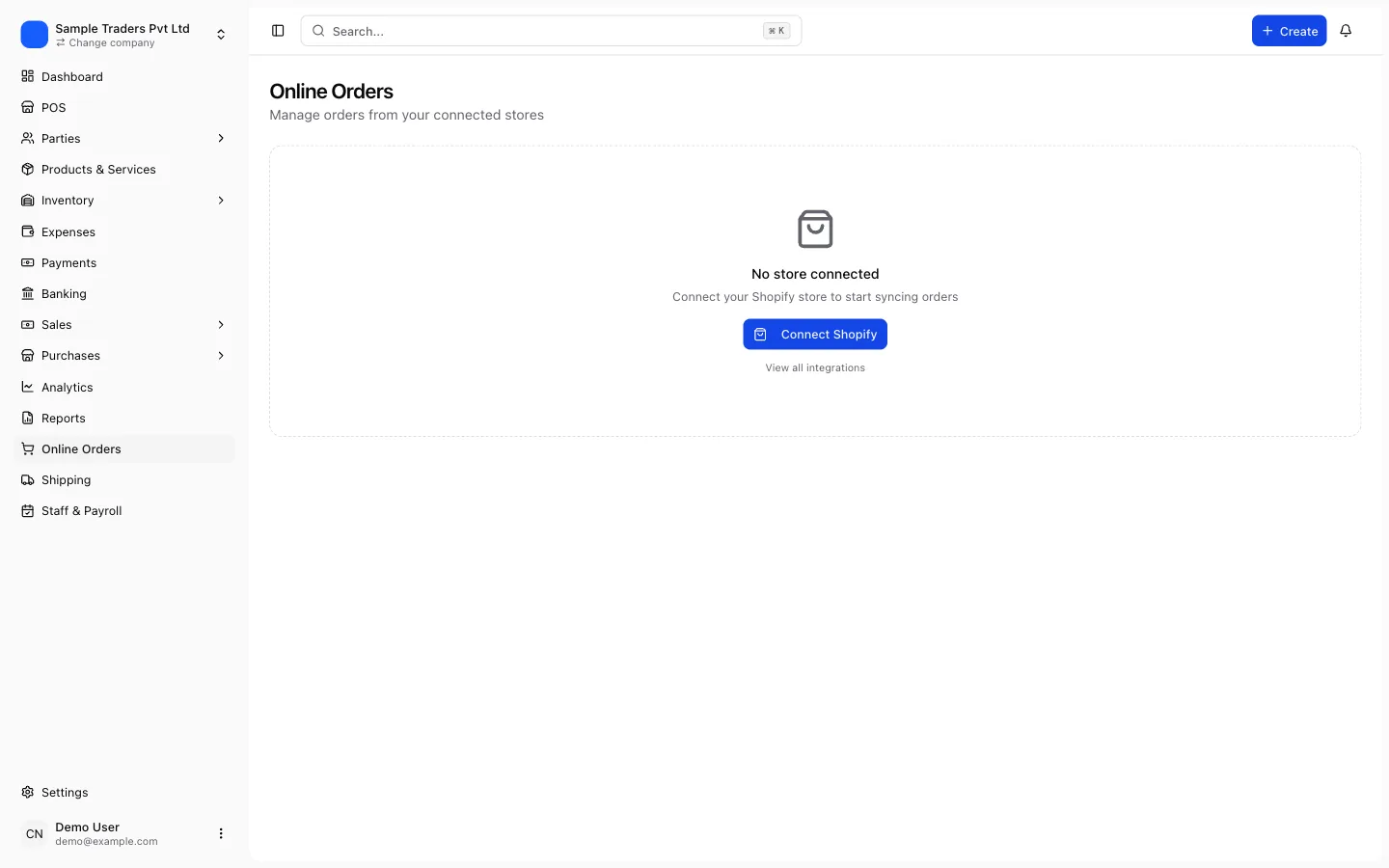
Whether you use an app or enter orders manually, the setup is the same.
- Map every Shopify product or variant to an item in the product master with its HSN, unit and rate. Rates must be 5, 18 or 40 percent; the 12 and 28 percent slabs ended on 22 September 2025. The HSN lookup shows the current code and rate.
- Set the invoice series for the store, separate from any offline series, so Table 13 can report it as one range.
- Decide how shipping is treated: as a line that follows the goods' rate, which is the composite supply rule.
- Decide the invoice trigger: on order for prepaid, on fulfilment for COD. Issuing at dispatch is the safe default for both.
- Capture the customer's GSTIN where they supply one, so B2B invoices are marked B2B.
The guide to creating a GST invoice covers the document itself, and the invoice number format rules cover the series.
GSTR-1 tables for a Shopify store
Once every order has an invoice, GSTR-1 is a grouping exercise.
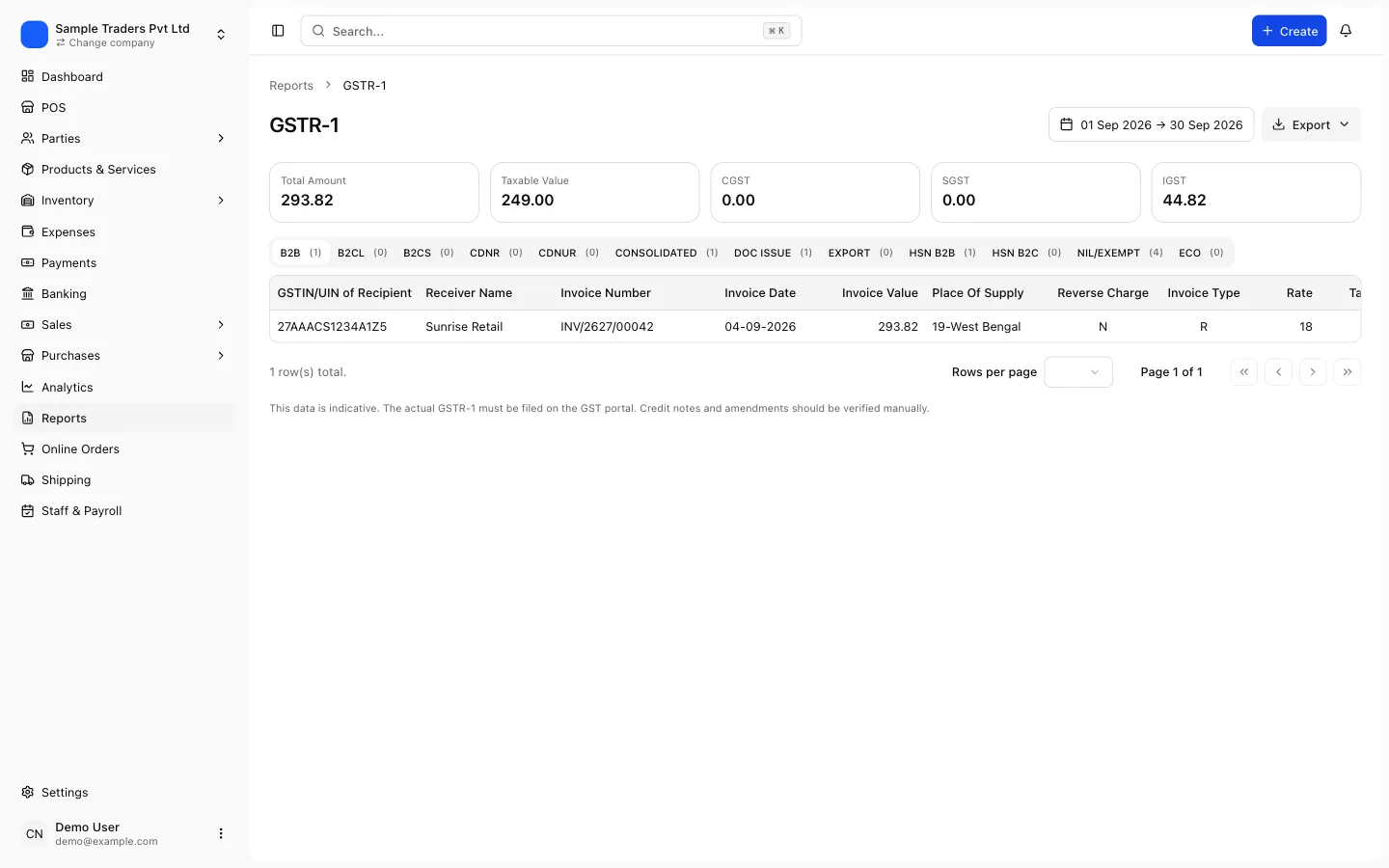
Where Shopify orders land in GSTR-1
| GSTR-1 table | What goes there | Shopify source |
|---|---|---|
| Table 4 (B2B) | Invoices to customers who gave a GSTIN, at invoice level | Orders with a customer GSTIN |
| Table 5 (B2CL) | Inter-state invoices to unregistered customers above the threshold, currently Rs 1 lakh, at invoice level | Large inter-state orders; check the portal for the threshold |
| Table 6A (Exports) | Invoices shipped outside India, with or without payment of tax | International orders, with LUT details |
| Table 7 (B2C others) | All other unregistered sales, summarised by place of supply state and rate | Most orders |
| Table 9B (Credit and debit notes) | Credit notes to registered customers and against Table 5 invoices | Refunds and RTO on those orders |
| Table 12 (HSN summary) | Supplies by HSN and rate, B2B and B2C tabs | Product master |
| Table 13 (Documents issued) | Each series with first, last, total and cancelled | Invoice and credit note series |
There is no Table 14 entry for your store, because no operator collected TCS. If you also sell on a marketplace under the same GSTIN, those sales go into Table 14 and the store sales do not. Export orders need a Letter of Undertaking to ship without IGST; the export invoice format guide covers the document, and the GSTR-1 filing guide covers the return itself.
Table 12 requires HSN codes from the portal's master list since the May 2025 period, so a product master with a stale code fails every month until corrected. The Table 12 and 13 error guide explains the fixes.
Refunds, cancellations and RTO
Shopify records a refund as a payment reversal. GST needs a document. The rule is the same one marketplace sellers follow: if goods moved on an invoice, the reversal is a credit note under Section 34 against that invoice; if the order was cancelled before dispatch, the invoice is cancelled and counted in Table 13.
- Full refund after return: credit note for the whole invoice, dated when the goods were received back.
- Partial refund: credit note for the affected line only, at that line's rate.
- RTO on a COD order: the customer never paid and never received the goods, but the invoice was issued at dispatch. Credit note for the full invoice when the parcel returns.
- Replacement: credit note for the returned item and a new invoice for the replacement.
- Cancellation before dispatch: mark the invoice cancelled; no credit note.
Credit notes to unregistered customers on ordinary B2C sales reduce the net figure in Table 7; those to registered customers or against Table 5 invoices go to Table 9B. Declare them by 30 November following the financial year of the original invoice or the annual return date, whichever is earlier. The credit note and debit note guide covers the fields.
GSTR-3B: output tax, ITC and payment
GSTR-3B summarises GSTR-1 and adds the input side. Table 3.1(a) carries taxable outward supplies net of credit notes, which is Tables 4, 5 and 7 of GSTR-1 combined. Table 3.1(b) carries zero-rated exports. Table 4A(5) carries ITC from GSTR-2B.
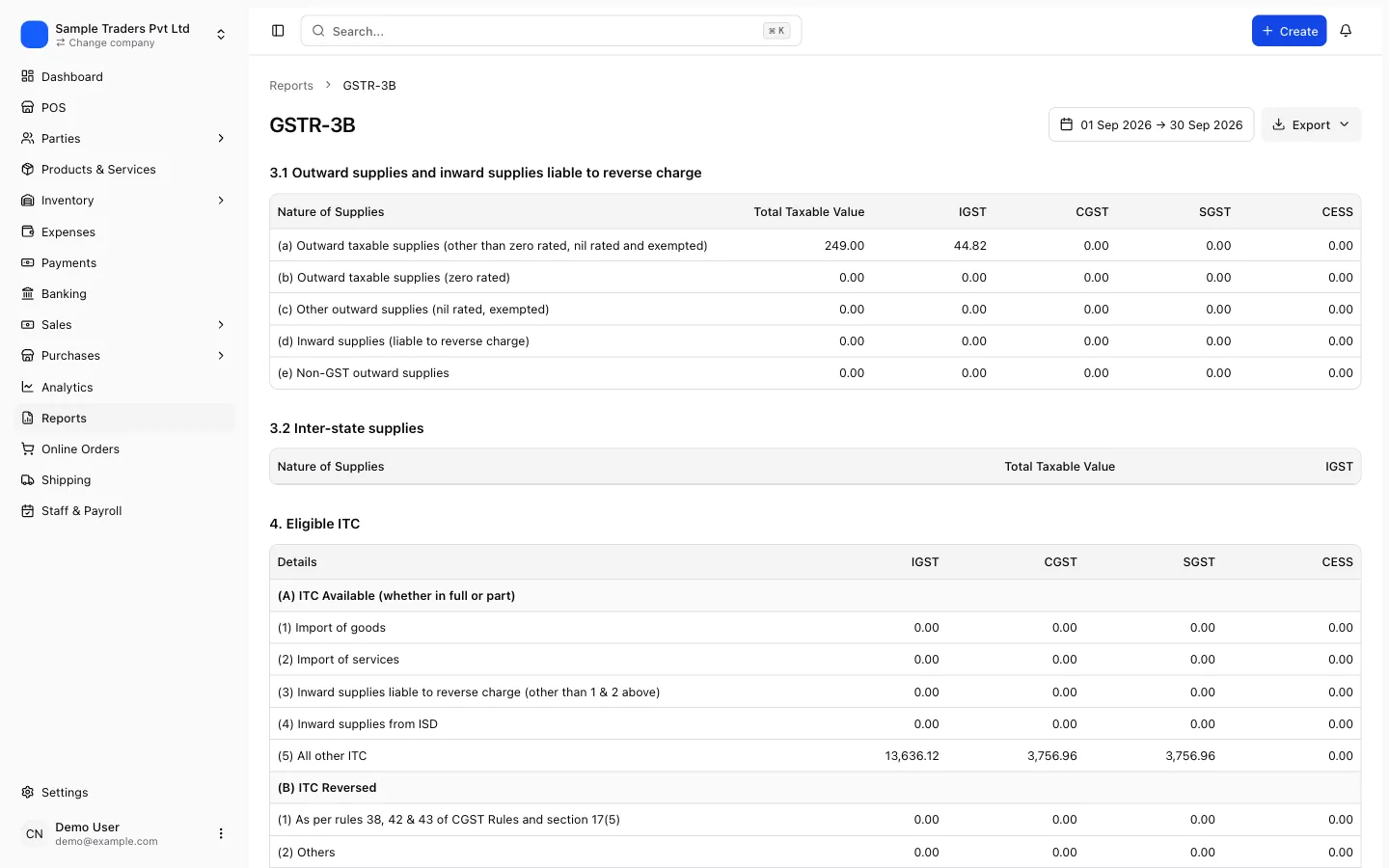
A Shopify seller's ITC comes from a few predictable sources.
- Payment gateway fees. Razorpay and similar Indian gateways charge 18 percent GST and issue monthly tax invoices with your GSTIN. Claimable once in GSTR-2B.
- Courier and shipping. Aggregators and couriers invoice at 18 percent; claimable on the same basis.
- Packaging, stock and consumables from registered suppliers.
- Shopify subscription and some app charges. If the invoice is from outside India with no Indian GSTIN, the charge is an import of services: pay GST under reverse charge in Table 3.1(d), then claim it in Table 4A(3). Check the invoice, and confirm the treatment with your CA.
Match every claim to GSTR-2B on the 14th before filing; the GSTR-2B reconciliation guide covers the routine. Pay any shortfall by challan and file by the 20th. A day late costs Rs 50, or Rs 20 for a nil return, plus interest. The GSTR-3B filing guide covers the table by table entries.
Payment gateway reconciliation
Your GST liability is on the invoice value, not on what the gateway settled to your bank after fees. A Rs 1,000 order settled as Rs 980 is still a Rs 1,000 supply, with output tax on the full taxable value, and the Rs 20 fee is a separate purchase with its own 18 percent GST invoice. Reconciling settlements against invoices catches two things: orders that were invoiced but never paid, which may need a credit note if they were cancelled, and gateway fee invoices you have not yet claimed.
Keep the order number or invoice number in the gateway payment reference so each settlement line ties to an invoice. Software that matches Razorpay payments to invoices does this automatically; the Razorpay settlement reconciliation guide covers the process by hand.
COD settles later, and sometimes never
Cash on delivery orders are invoiced at dispatch and settled by the courier weeks later, or not at all when the parcel returns. Reconcile COD remittances against invoices separately from gateway settlements, and raise the credit note for every RTO as soon as the parcel is back, not when the courier's remittance report arrives.
Filing calendar and thresholds to watch
Monthly filers submit GSTR-1 by the 11th and GSTR-3B by the 20th of the following month. Stores under Rs 5 crore turnover can opt for QRMP, with quarterly returns, the optional IFF for B2B invoices in months one and two, and monthly PMT-06 payments; for a mostly B2C store with steady volume, monthly filing is usually simpler.
Two thresholds change the process as you grow. Above Rs 5 crore aggregate turnover, e-invoicing applies to B2B invoices and each one needs an IRN from the Invoice Registration Portal; the e-invoicing guide covers the setup. From Rs 10 crore, invoices must be reported to the IRP within 30 days of the invoice date. Separately, any consignment above Rs 50,000 needs an e-way bill regardless of turnover, which the e-way bill guide covers.
A monthly routine for a Shopify store
Month-end before GSTR-1
- Every fulfilled order in the period has a tax invoice with place of supply from the shipping address
- Every refund, return and RTO has a credit note against its invoice; cancellations marked cancelled
- Shipping lines taxed at the goods' rate; no 12 or 28 percent items in the product master
- B2B orders carry the customer's GSTIN
- Export invoices carry LUT details and go to Table 6A
- Gateway, courier and app invoices downloaded and matched to GSTR-2B
- Reverse charge on foreign service invoices computed
- Table 12 and Table 13 generated from invoice data, not typed
Software that creates the invoice from the Shopify order, links the credit note to it, matches the Razorpay settlement, and then builds the GSTR-1 tables and a GSTR-3B summary from those same records removes the retyping where mismatches are born. myBillPlease does this with its Shopify app, GSTR-1 JSON export and Razorpay reconciliation, free for up to 100 invoices a month.
A Shopify store's GST is simpler than a marketplace seller's, provided the invoice is created at the order. Everything else in the return is a grouping of documents that already exist.
Frequently asked questions
- Does Shopify collect TCS like Amazon or Flipkart?
- No. TCS under Section 52 is collected by an e-commerce operator that owns the platform through which other suppliers sell and that collects the consideration.
- Do I need GST registration for a small Shopify store?
- If you ship goods to customers in other states, yes, regardless of turnover, under Section 24(i). Only a store that sells goods within one state stays under the threshold rules.
- Which GSTR-1 table do Shopify orders go in?
- Orders from unregistered customers go to Table 7, summarised by place of supply state and rate, with any inter-state invoice above the large-invoice threshold (currently Rs 1 lakh, check the portal) in Table 5.
- How do I handle a Shopify refund in GST?
- A refund in Shopify is a payment event, not a tax document.
- Is GST charged on shipping charges in a Shopify order?
- Yes. Shipping charged with the goods is part of a composite supply and takes the rate of the principal goods, so a shipping line on a 5 percent product is taxed at 5 percent.
- Can I claim ITC on Shopify subscription, app and payment gateway charges?
- Payment gateway fees from an Indian provider such as Razorpay carry 18 percent GST on a tax invoice with your GSTIN and are claimable once in GSTR-2B.